The historic city of Jugha was located near the village of Jugha in the Julfa district, within the territory of present-day Nakhichevan, on the left bank of the Arax River. It stretched over more than 2 km from east to west, from the Arax River to the nearby mountain slopes, with a width of 400–500 m. During the 15th–17th centuries, it was one of the prominent trade centers of Armenia.
According to the archaeological site of Jugha and historical sources, the city consisted of over 10 large districts, populated only by Armenians, and had 7 famous churches and several chapels and shrines, along with various secular buildings. It was also renowned for its cemetery. Traveler Alexander Rhodes, who visited Jugha in 1648, testified that more than 10,000 khachkars had been preserved here. The earliest khachkars date back to the 9th-10th centuries.
Jugha Cemetery
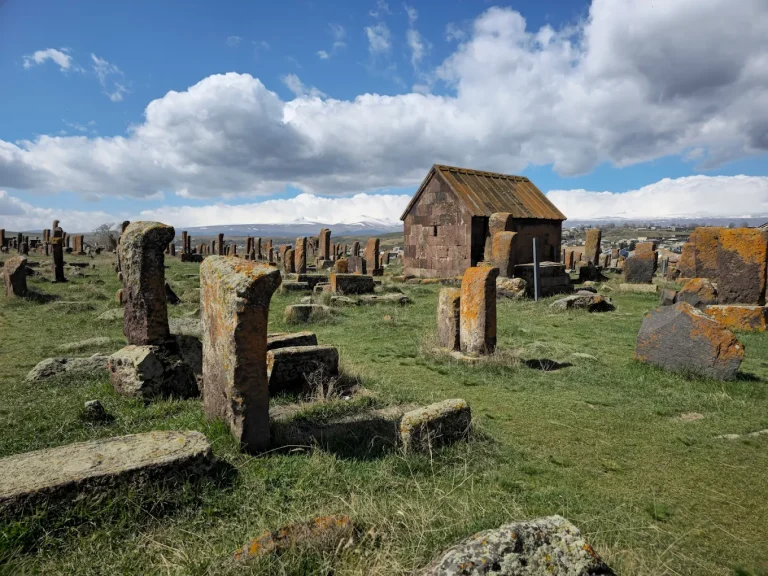
The cemetery was located in the western part of the city, on and around three hills separated by small canyons, covering an area of more than 600 square meters. It was a half-ruined forest of khachkars, unique in the world for its vastness, diversity and artistic execution of numerous khachkars.
The embroidery brought to the finest detail, covered with lace and various ornaments. The expressive and dynamic bas-reliefs, along with all-encompassing lithography, showcase the high art of artistic stone processing. The khachkars of Jugha clearly occupy a special place not only in Armenian but also in world sculptural art. They mark the culmination of the historical development of khachkars, which are considered a unique achievement of Armenian art.
In 1914, while traveling through Gokht, the talented artist Martiros Saryan visited the cemetery and wrote:
“In Julfa, we saw the brilliant khachkars of Jugha. And the railway passed through this forest of khachkars. And the railway passed through this forest of khachkars. Khachkars struck me with their unique artistic value, amazing variety of motifs and rhythm. At the same time, I was shocked to see that some of them were destroyed during the construction of the railway.”
The art of the Jugha khachkars was different from the khachkars of the previous period and those of neighboring territories. Firstly, the length of the Jugha khachkars is three to four times greater than their width. Secondly, the slabs do not taper toward the base and do not have a pedestal. On the cornices of the khachkars, images of Christ, the Evangelists, and the Holy Mother of God are often found. The lower part of the stone frequently features sculptures of the deceased and inscriptions.
Destruction of the Khachkars of Jugha
A significant part of the city’s ruins, in addition to those destroyed over time, was demolished by treasure hunters starting from the 17th century, as well as by landslides from the mountains near the city. While there were about 10,000 khachkars in the 17th century, by the end of the 20th century, only 3,000 khachkars remained in Jugha.
During the construction of the railway in 1903–1904, which passed through the territory of Jugha, half of the khachkars were irreversibly destroyed.
After Jugha’s destruction, many Armenian and foreign travelers visited its ruins, sorrowfully describing the miserable remains of the once bustling and beautiful city.
2005 Destruction
On December 15, 2005, the Azerbaijani government organized and carried out a multi-stage destruction of approximately 5,000 khachkars at the old Jugha cemetery in Nakhichevan during broad daylight, using military units. The armed forces of Azerbaijan shattered the last remnants of the khachkars with heavy hammers and transported the pieces by trucks, dumping them into the Arax River — a crime recorded from the Persian coast, broadcast worldwide, and condemned by the European Parliament.
Restoration Efforts
A year after the final destruction of the Jugha khachkars, restoration efforts began. Today, many replicas of the Jugha khachkars are being produced and installed in churchyards and various parks. In Gyumri, 20 copies of the Jugha khachkars have been erected.