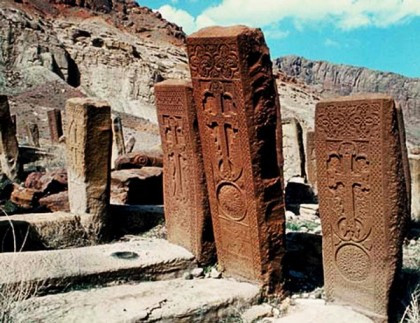
In the Gegharkunik region, on the right bank of the Gavaraget River, lies the village of Noratus, renowned for its ancient monuments.
The Monuments of Noratus
The village of Noratus is located approximately 95 km from Yerevan, at an altitude of 1,925 meters above sea level, on the shores of Lake Sevan.
Ancient tombs have been discovered near Noratus. Artifacts found in the area, such as belts, arrows, bracelets, and ceramics, indicate that this region was inhabited as early as the Bronze and Iron Ages.
At the center of the village stands the Church of Saint Astvatsatsin, built by Prince Sahak in the late 9th century. The church’s domed hall was entirely constructed from large hewn stones. Its courtyard is filled with numerous khachkars (cross-stones) and tombstones. The oldest inscription, engraved on a khachkar dating back to 996, is now exhibited in the History Museum of Armenia. Though the church was once destroyed by invaders, it was rebuilt and remains active today.
On the southeastern outskirts of the village stands the Church of Grigor Lusavorich. Though commonly dated to the 13th century, inscriptions and architectural evidence suggest it was built before the 10th century. An inscription on the western wall of the monastery mentions Prince Herak (Heracles) of Havnun. According to Catholicos Simeon of Yerevan, the monastery was called Doputs (Dapunts, Dahira).
About 2 km northeast of the village, on a hill, lies a chapel. This small, single-nave structure, measuring six square meters, is carefully designed. The western wall is lined with khachkars, and the surrounding courtyard contains the ruins of monastic cells.
The most famous landmark of Noratus is the southern cemetery, often referred to as the “Forest of Khachkars.”
The Khachkar Forest
The Armenian art of khachkar carving, which began in the early Christian period and flourished in the Middle Ages, is recognized as part of UNESCO’s Intangible Cultural Heritage of Humanity.
After the destruction of the Djulfa Cemetery, Noratus became the largest khachkar complex in the world. Between 1998 and 2005, approximately 2,500 khachkars from the historic Djulfa Cemetery were destroyed by Azerbaijan.
The Noratus Cemetery itself contains around 2,500 khachkars and spans 7 hectares. These cross-stones, dating from the 9th to the 18th centuries, serve as tombstones, preserving the memory of ancestors. No two khachkars are alike—each is distinct in its carving techniques, ornamentation, and compositional features.
Most khachkars date from the 13th to 17th centuries and are arranged in family burial clusters. Some stand as tall as 1.5 meters.
Legends of Noratus
There are several folk legends about the khachkars of Noratus, with two being the most well-known.
One legend tells of an invasion by the Turks into Gegharkunik, when Prince Gegham had only a small number of soldiers. He ordered his troops to dress the khachkars in military uniforms. From a distance, the enemy believed they were facing a vast army and fled in fear, allowing Gegham’s forces to attack and defeat them.
Another legend is tied to a small chapel near an ancient burial site. It is said that when the Tatars invaded the village, they made a pact with the village elders to spare the lives of all those who could fit inside the chapel. The villagers escaped through a secret exit, and when the Tatar commander entered, he saw only a few people praying. Believers attribute this “miracle” to divine intervention, saying the people were transformed into doves and flew into the sky.