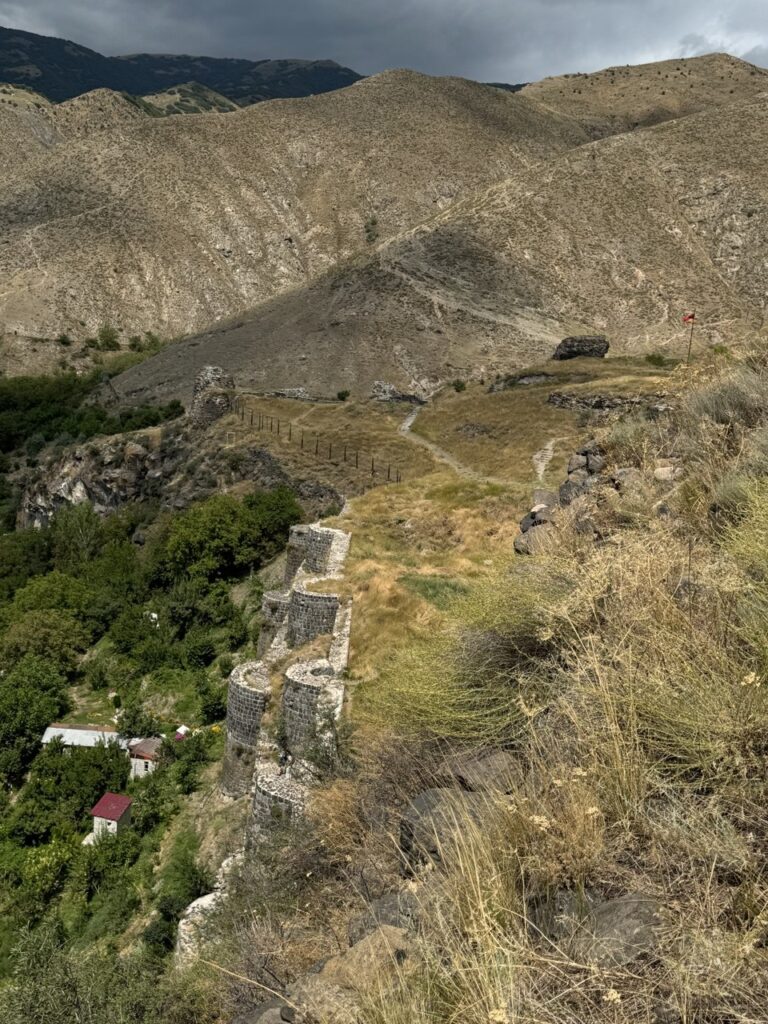
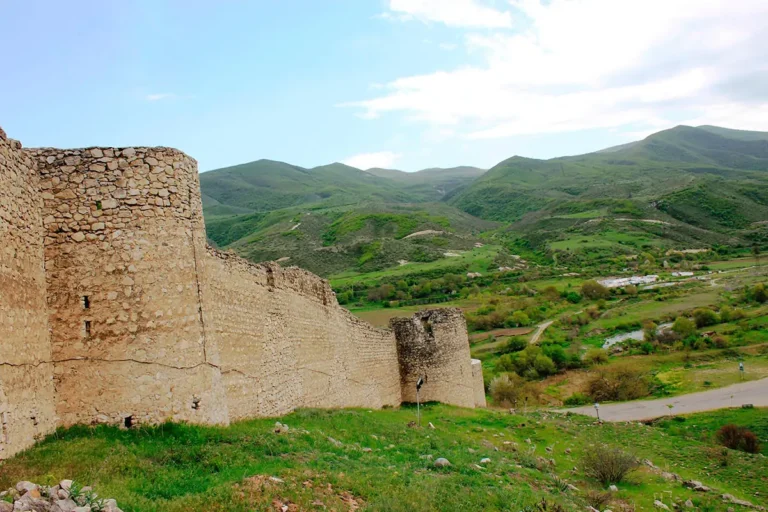
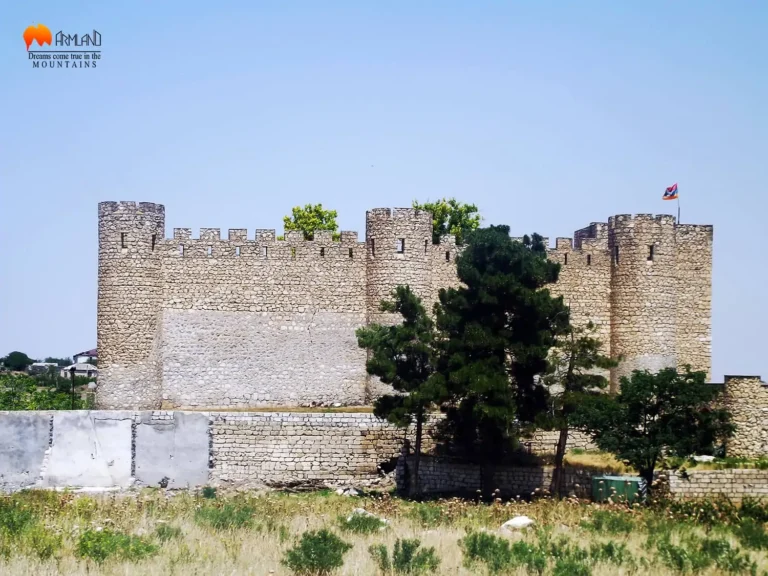
On the northern side of the village Kosh in the Aragatsotn Province lies a complex consisting of the Kosh Fortress and the St. Stepanos Church. The church stands on the slope of the valley to the northeast of the village.
The Kosh fortress is located on the top of a mountain. The fortress dates back to the 13th century. South of the village stands a khachkar (cross-stone) made of red tuff, which is approximately seven meters tall. According to its inscription, the fortress was constructed to commemorate the liberation of Aragatsotn from the Seljuk turks.
St. Stepanos Church
The church is built of yellow-red and brown polished tuff. It is a cross-shaped domed structure. Sacristies are located on either side of the main altar. The church is richly adorned, showcasing intricate details.
Kosh Fortress
The fortress has rectangular corners and round towers. It is built from large stone blocks. Its entrances are on the northern and southern sides. There are numerous references to the early Iron Age, as well as ruins of residential buildings constructed from basalt stones. The fortress holds significant historical and archaeological value due to its well-preserved integrity.
Tradition
Kosh Fortress is also known as the “Maiden’s Fortress” due to a local legend. According to the story, the conqueror Tamerlane (Lenk Temur) learned of a beautiful girl living in the fortress and sent soldiers to capture her. Three soldiers kidnapped the girl, but a shepherd followed them. At night, while the soldiers were asleep, the shepherd killed them and brought the girl back to the fortress. Learning about this Lenk Temur furiously attacked the Armenians fortified in the fortress. With the help of an old woman, he cut off the water supply to the fortress and thus defeated the Armenians. Witnessing this, the girl threw herself into the river from the fortress walls, leading to its name as the “Maiden’s Fortress.”
The Village of Kosh
The village of Kosh is located at an altitude of 1250 meters above sea level. In ancient times, it was called Kvash and was considered to be a part of the Aragatsotn province in the Ararat region of Greater Armenia. According to legend, Kush, the son of the biblical Canaan, lived here, and the name Kvash emerged as a distortion of his name.