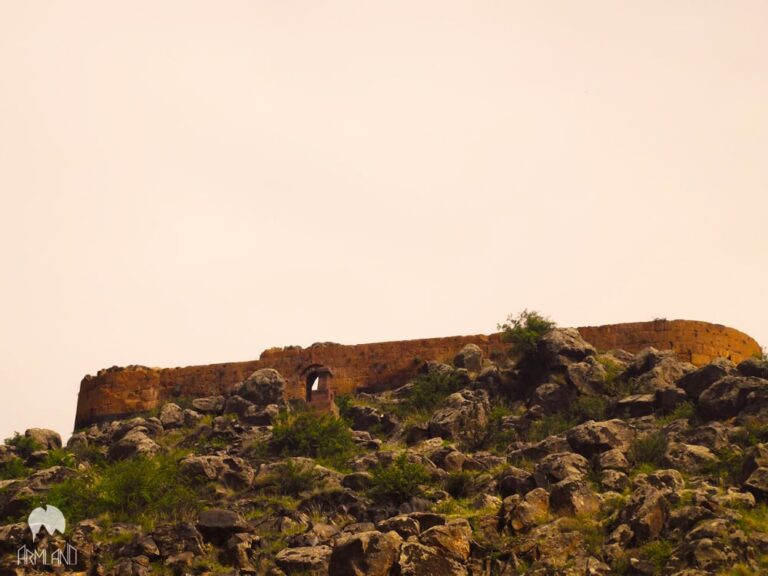
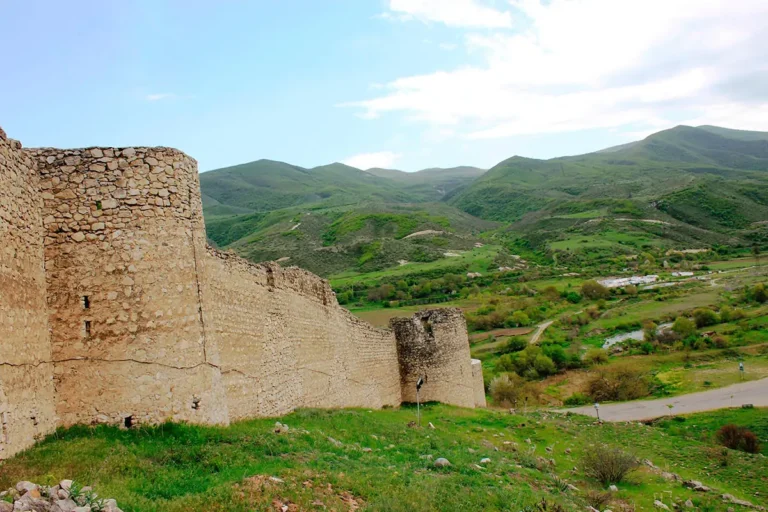
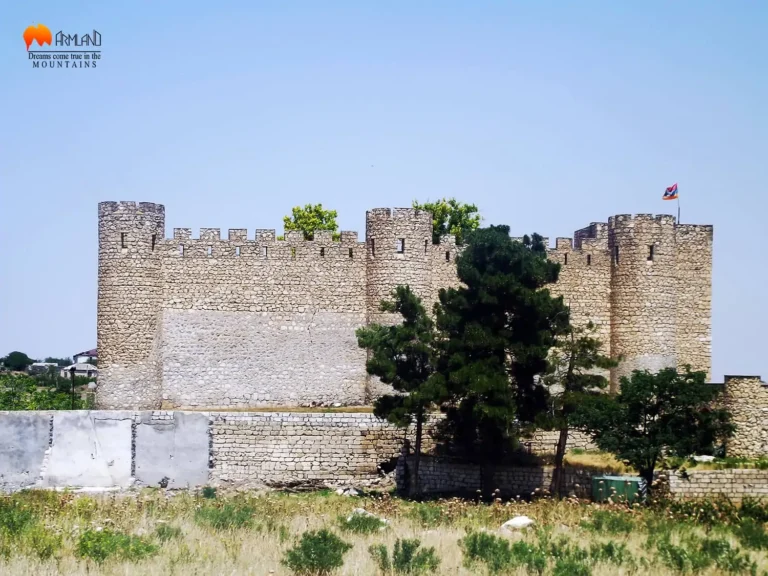
The Fortress of Bjni is one of the well-known structures of medieval fortress architecture. It is located in the village of Bjni, Kotayk region, on the promontories near the village, on both banks of the Hrazdan River. It is registered in the State List of Immovable Historical and Cultural Monuments, considered state property of the Republic of Armenia. The fortress is protected by the SNCO “Service for the Protection of Historical and Cultural Museums-Reserves and Historical Environment” under the Ministry of Culture of the Republic of Armenia.a
For a long time, it was believed that the Bjni Fortress was built by the Pahlavuni princes in the 10th-11th centuries. However, during excavations in the 1970s, much older structures were discovered: church walls, a palace, residential buildings, a reservoir, and an underground tunnel. In the Middle Ages, the Pahlavuni princes reconstructed the old church, making it one of the strongest fortresses in Armenia.
The fortress was destroyed and abandoned in the 16th-17th centuries. In 1977-1978, an expedition led by Garibyan conducted excavations here, which uncovered the Church of Surb Khach (Holy Cross), dating back to the 9th-10th centuries.
In 2007-2008, the fortress walls, the foundations of the secular building and the adjacent structure, the churches were restored, the reservoir and the beginning of the underground passage were strengthened.
The Village of Bjni
The village of Bjni was first mentioned in the 5th century. From the 11th century, Bjni was referred to as a city-fortress. During this period, Bjni served as the residence of Vasak Pahlavuni.
Bjni became one of the four episcopal sees of Armenia, responsible for electing the Catholicos. In 1072, Bjni fell under the control of the Seljuk Turks, suffering destruction and looting. In 1201, Armenian forces recaptured Bjni, and it came under the jurisdiction of the Zakarid dynasty, later becoming the residence of Atabek Zakarian the Elder. In 1386, Bjni was raided by the forces of Lenktemur (Tamerlane).
In the 13th-14th centuries, Bjni was the seat of the Archbishop of the Ayrarat Province, who was one of the four supreme bishops of Eastern Armenia, with a decisive voice during the election of the Catholicos. Bjni was also a center of Armenian literature.
In the eastern part of Bjni, at the top of a hill, the Church of Saint Sarkis was built in the 7th century. Due to its extremely small size (it is the smallest of its kind in Armenia), the construction is very simplified. On the plateau, the Pahlavuni princes established the fortress in the 10th-11th centuries, which for centuries was the main fortification of the Nig Province. The ruler of the Bjni Fortress was Vasak Pahlavuni, whose son, Grigor Magistros, built the Church of Saint Astvatsatsin (Holy Mother of God) in 1031, which still stands today.
Structure of the Bjni Fortress
The area of the fortress is naturally divided into two parts: the larger and the smaller. The smaller part, located 10-15 meters below the larger one and covering an area of 1,200-1,500 square meters, housed the lower fortress, while the upper fortress occupied the rest of the hilltop.
In the large fortress, a vaulted reservoir built of basalt stones and plastered with lime mortar was discovered.
On the southwestern side of the smaller or lower fortress, there was a secret passage with a vaulted and arched entrance leading to the Hrazdan River. Remarkably, the secret passage leading to the Hrazdan River by the castle walls still exists today, but passing through it is not recommended for safety reasons. The entrance to the castle is on the northern side.
Historical and Cultural Monuments of the Fortress
- The Church of the Holy Cross
- The Palace Structure
- The Grain Storage
- The Secret Passage
- Production and Residential Complexes
The Impregnable Fortress
The Bjni Fortress stands at an elevation of 1,504 meters above sea level. The view from the fortress is stunning, with all of Bjni, the Hrazdan River, and the Church of the Holy Mother of God—founded in 1031 by Armenian Prince Grigor Magistros Pahlavuni—visible from above.
The fortress is protected on one side by deep gorges and on the other by fortress walls reinforced with semicircular towers. The length of the fortress wall is 120 meters.
During the rule of Vasak Sparapet, the brother of Prince Vahram Pahlavuni, and his son Grigor Magistros, double walls were built for defensive purposes. The second row of walls was higher than the front walls. Due to its exceptionally favorable natural location, the Bjni Fortress was one of the most impregnable defensive complexes of medieval Armenia. The walls built during the Pahlavuni era were later repaired and strengthened during the rule of the Zakarids until the 14th century.
Some of the walls have been preserved to this day.