Harichavank, one of the medieval monastic complexes of Armenia, is located in the village of Harich in the Shirak region, on the northern slope of Mount Aragats, on a promontory formed by two canyons. The monastery was built between the 7th and 13th centuries. It is one of the remarkable monuments of medieval architecture, rich with exquisite bas-reliefs.
Structure of the Monastery
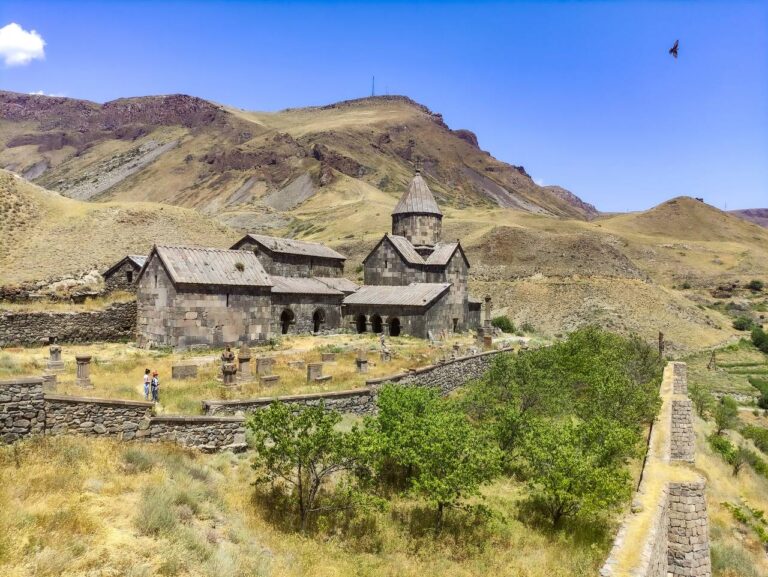
The complex consists of two churches (St. Grigor and St. Astvatsatsin), a narthex, storage rooms, a bell tower, a chapel, a school, and other buildings. The oldest building is the Church of St. Grigor, built in the 7th century. Next to it there are two-story chapels built in the 13th century.
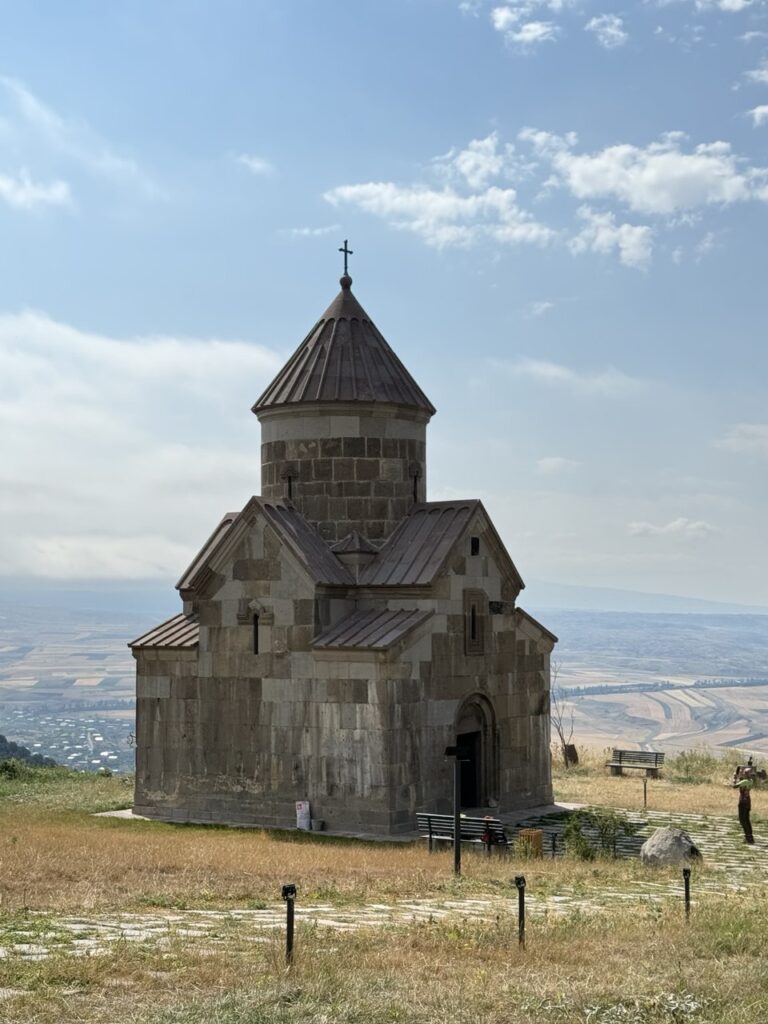
The Church of St. Grigor is a cruciform-domed church with a rectangular sacristy on the southeastern side. The apses are pentagonal on the outside and semicircular on the inside. The enormous dome gives the church a majestic appearance. The church has undergone multiple reconstructions, during which the dome lost its original shape.
The main church of the monastery was built by order of the brothers Zakare and Ivane in 1201 and is a cruciform-domed structure. The church’s interior is quite modest, while its exterior is richer. Among the decorations are sundials, doves, and a high-relief sculpture of the Zakarian brothers holding a miniature church, which was later replaced by an onyx icon of the Holy Mother of God. All the buildings of the monastery are constructed from colorful stones laid in a mosaic-like pattern.
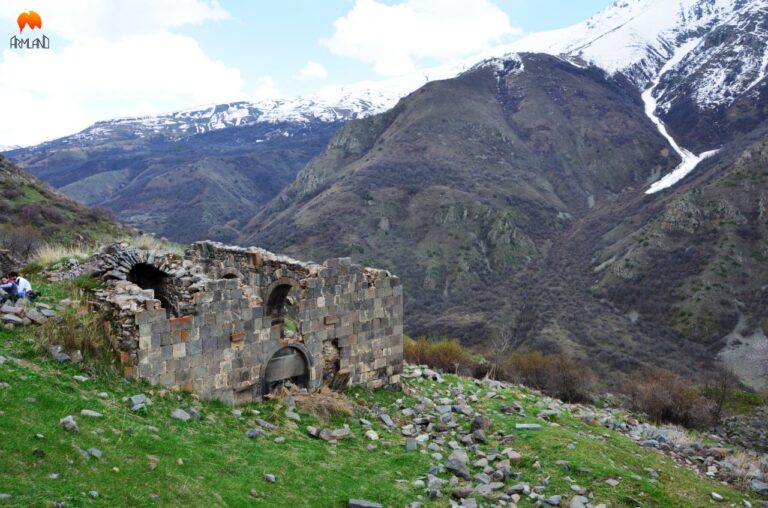
Of particular interest is a small chapel located near the monastery complex, built on a rock, which, during an earthquake, separated from the main rock mass and, despite its tilted state, has survived almost intact to this day.
The monastery was also a center of learning. The famous school that operated there in 1887-1889 was attended by Avetik Isahakyan. In 1850, Harichavank became the summer residence of the Catholicos. Today, there is a functioning school for clergy where future priests study and receive education.
Legends of the Monastery
- The Legend of the Princess:
According to one legend, a princess, fleeing from the Seljuks, hid in the chapel built on the rock. When the Seljuks attempted to capture her, the rock split into two parts. Frightened by such a miracle, the Seljuks retreated, and the princess was saved. - The Legend of the Pigeons:
During one of the Seljuk invasions, many people hid inside the church. However, when the Seljuks entered the church, it was empty. The invaders thought a miracle had occurred and believed the people had turned into doves by the power of the Holy Spirit and escaped. In reality, the church had a secret exit that allowed people to descend into the valley. Angry at finding no one, the Seljuks decided to destroy the church. They started with the narthex, tying ropes to the columns and trying to pull down the foundation using oxen and horses. But the oxen and horses ended up suspended in the air. The narthex remained unharmed, and the Seljuks, seeing this as a bad omen, abandoned Harichavank. The monastery survived, and the columns were later attached to the foundation with a special mortar.
The Secret Passage
In one of the buildings near the church, there is a tile on the floor that can be rocked with your foot. Beneath it is a hidden underground passage leading to the gorge and beyond. It is believed that through this network of underground tunnels, it is possible to reach Ani, the ancient capital of Armenia (now located in present-day Turkey), which is approximately 40 kilometers away in a straight line.