Located 7 km west of Kapan, the regional center of Syunik, on the right bank of the Voghji River, one of the most renowned monasteries of medieval Armenia, Vahanavank is located. It was founded in the 10th century by Vahan, the son of Dzagik, ruler of the Baghak province in Syunik. The monastery is named in his honor, “Vahanavank.” It is also known by other names, such as Hovhanavank or the Monastery of Hovhannes, as referenced by Vardan Areveltsi, Ghevond Alishan, and others.
Architectural Structure
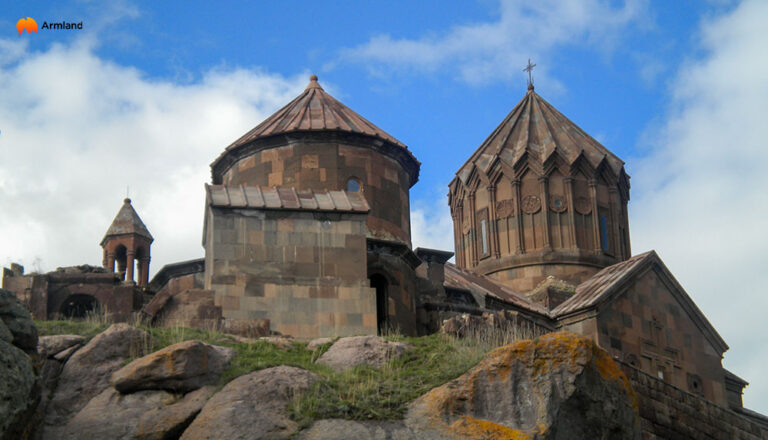
The monastic complex consists of the Cathedral of St. Gregory the Illuminator (built in 911), the vestibule, the colonnade (mid-11th century) and the two-story Church of St. Astvatsatsin (built in 1086).
The main church of the complex is the Cathedral of St. Gregory the Illuminator. It is a central-domed building with a cruciform plan, built of local reddish basalt. It has two entrances: one on the west and another on the south.
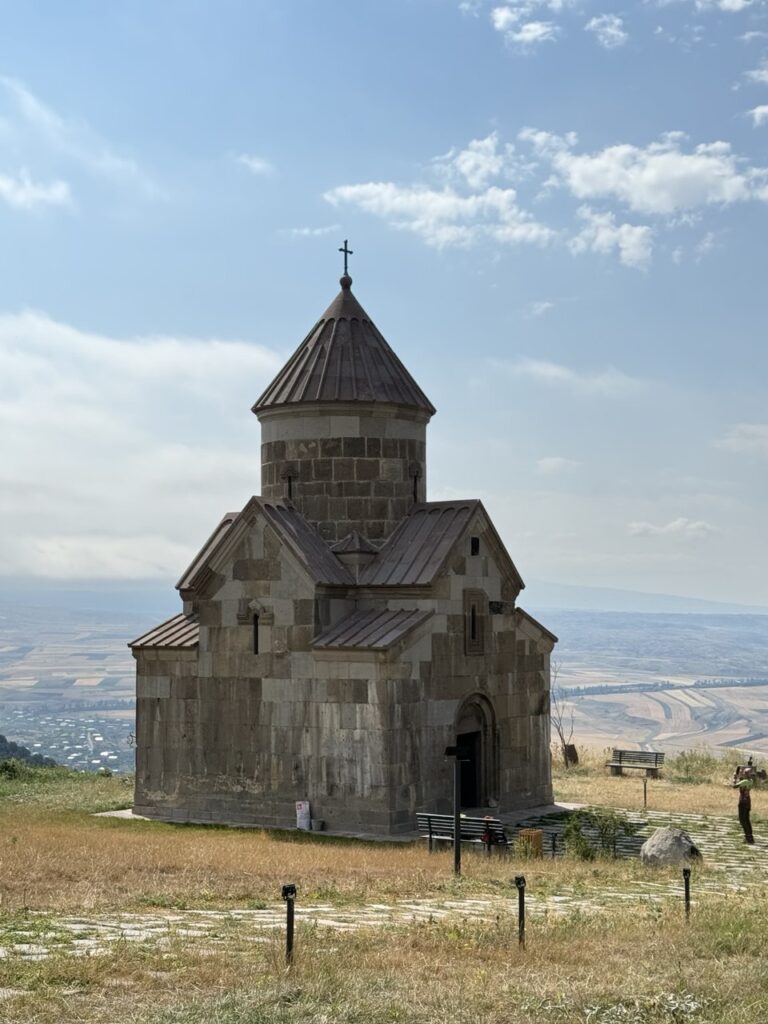
In 1086, the two-story Church of St. Astvatsatsin was constructed about 70 meters away from the main cathedral. A lithographic record has been preserved about the construction of this church. According to the inscription, it was built by Queen Shahandukht II and her sister Kata. It is a two-story vaulted, small, single-nave church, that has a columned balcony to the north and east. Historical records suggest that the monastery also included two other churches, St. Harutyun and St. Sion, though their exact locations remain unidentified.
Vahanavank housed about 100 monks and operated a monastic school, whose notable students included Vahan I Syunetsi, the nephew of the monastery’s founder.
The monastery contains the graves of Prince Vahan, Sahak Sevada II, Queen Sopi, Prince Ashot, his heirs Smbat II and Grigor I, and four other kings of the Syunik Kingdom. The grave of Prince Vachagan’s mother, Khashush, is also located here.
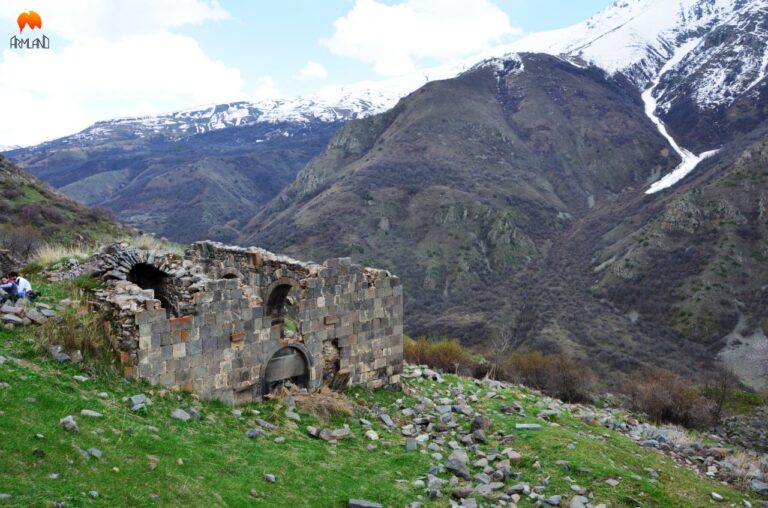
Excavations have been carried out since 1966, and restoration efforts have been ongoing since 1978. Between 2006 and 2009, the Cathedral of St. Gregory the Illuminator and its adjoining gavit were completely restored.
There is a theory that Davit Bek, the leader of Syunik’s liberation struggle from 1722 to 1728 was also buried in Vahanavank. This hypothesis was put forward by the Armenian writer Sero Khanzadyan in his historical novel “Mkhitar Sparapet”. However, this claim has not been confirmed in any way to this day. Historians argue against it, citing that Vahanavank was in ruins during Davit Bek’s era, making it unlikely that he would have been buried there.